 Ridvan Senturk, PMP
Scope of the confidence value. high describes this article's explanation of established planning and resource practice, and the arithmetic of the worked example. It does not extend to any claim about how often the situation described occurs, to any causal allocation within the example, or to any comparison between planning methods.
The situation — synthetic example
One workfront. 3,840 remaining labour hours. A window of 20 working days, and 30 qualified workers assumed available. Required average: 24.0 worker-equivalents.
Then the trade ahead finishes eight working days late, and the handoff date after you does not move.
With scope and effort assumptions held constant, the remaining hours are unchanged. What does the shorter window do to the labour forecast?
In brief
Article 002 reconciled the labour a schedule demands against the crew a contractor assumes it can field. It took workfront availability as given. This article is about that dependency. It explains make-ready planning for a CPM audience and traces how a changed release assumption affects the labour forecast. Nothing here is new — the methods described are established and cited. What the article does is follow one connection from the seat of a specialty subcontractor's forecast.
1. Your forecast depends on workfront availability
Time-phased labour demand depends on when the work can be performed.
You can defend the remaining hours — that was Article 001. You can defend the profile, the calendar, the assumed availability and the reconciliation between them — that was Article 002. Neither establishes that the workfront will be open when the profile places a crew in it. Resource arithmetic and physical availability are different questions.
An external release date may come from another party's plan. Detailed knowledge of the subcontractor's own work does not establish whether that release assumption is current or confirmed.
So before the planning material, the arithmetic.
2. The arithmetic of a window
The example is synthetic — one trade, unnamed, on a project that does not exist. Monday to Friday, eight hours per person per day, no overtime, no statutory holidays modelled. Those assumptions are stated so every figure below can be checked.
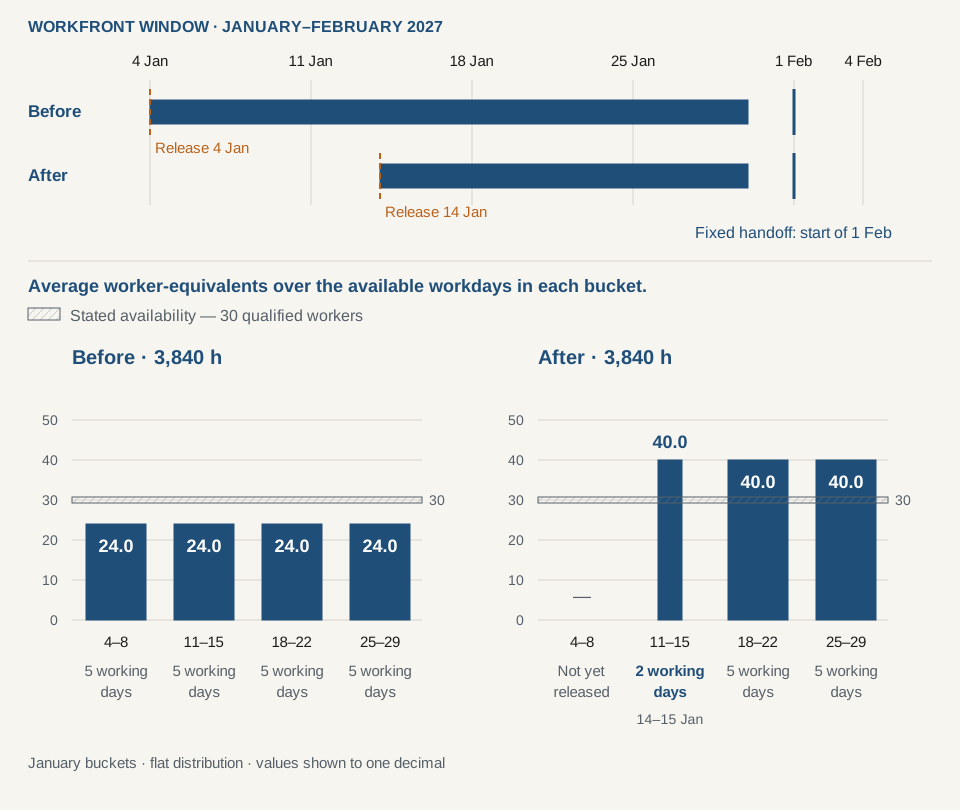
A workfront — call it Area B — carries 3,840 remaining labour hours and is released by a predecessor trade the subcontractor does not control. Release was planned for Monday 4 January 2027. A fixed handoff falls at the start of Monday 1 February, so the work must finish by the end of Friday 29 January.
That is a window of 20 working days. One worker provides 160 hours in it, so the work requires 3,840 ÷ 160 = 24.0 average worker-equivalents against a stated availability of 30 qualified workers.
The required average is below the stated availability. Daily loading and workfront feasibility still need checking.
Then the release moves. The predecessor finishes eight working days late and the work becomes available on Thursday 14 January. The handoff does not move.
The window is now 12 working days. One worker provides 96 hours in it. The same 3,840 hours require 3,840 ÷ 96 = 40.0 average worker-equivalents against the same 30.
With the same scope and effort assumptions, total hours are unchanged; the required average labour rate rises by two-thirds.
The same shortfall can be expressed as average demand, hours or additional working time:
| Expressed as | Calculation | Result |
|---|---|---|
| Average labour demand | 40.0 − 30 | 10 average worker-equivalents short |
| Hours | 3,840 − (30 × 96) | 960 hours that do not fit inside the window |
| Time, if capacity binds | 3,840 ÷ (30 × 8) = 16 working days, from 14 January | Finish at the end of 4 February — four additional working days beyond the 29 January work cutoff, missing the start-of-1-February handoff |
The time result assumes all 30 workers can perform the modelled work throughout, with no further blocking condition.
Notice what the arithmetic does not do. It does not say productivity will fall because people are stacked — that is a separate question with its own estimating basis, and Article 001 is where it belongs. It does not give a daily peak: 40.0 is an average across a window, not a roster. It does not say the answer is more people.
The release assumption changed, so the forecast needs reassessment. Which raises the question this article is actually about: who carries the changed release assumption into the resource decision?
3. Make-ready planning, for a CPM reader
The planning tradition that takes that question as its subject has been in use for decades, and a project-controls reader may have met it mainly as something the field does in a room with sticky notes.
The Last Planner System is described by the Lean Construction Institute as "a system for project production that promotes the creation of a predictable workflow among various parties so that it achieves reliable results."1 LCI presents five planning conversations; that is the framing used here.1
Figure 2
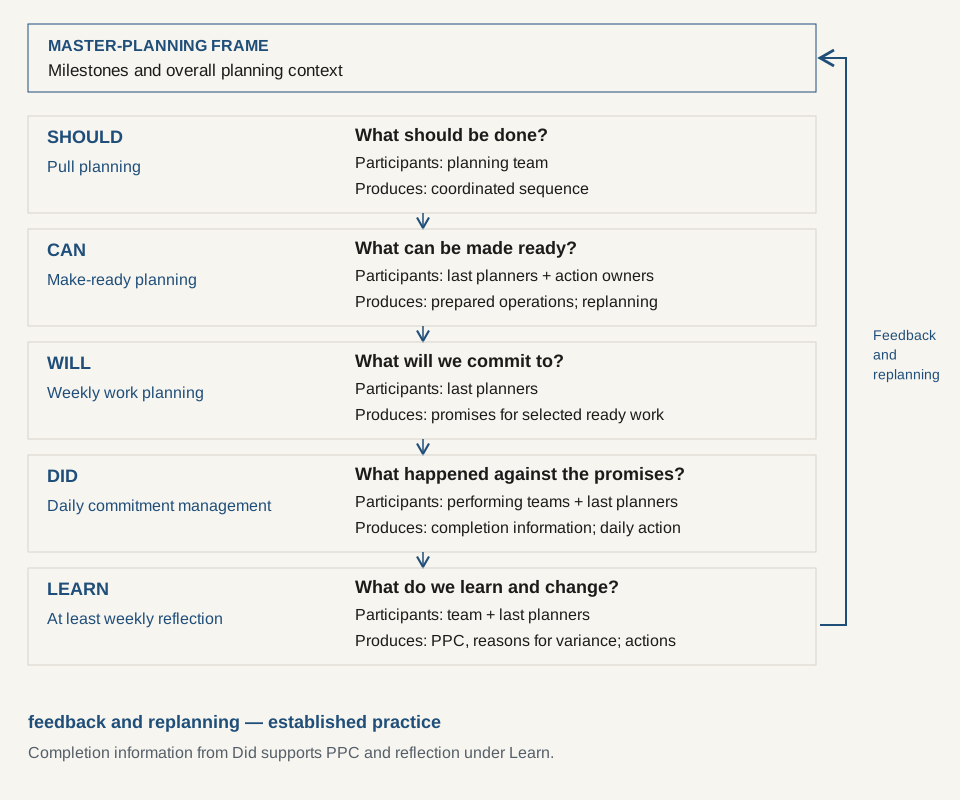
- Should — "Pull-planning establishes what should be done."
- Can — "Make-ready planning gets the upcoming work in a condition so that it can be done."
- Will — "Weekly work planning establishes the set of promises from specific people for the work that will be done."
- Did — "Daily commitment management supports the last planners in staying on track with their promises so that the work did get done."
- Learn — "At least weekly, the last planners take time to learn from their performance."
The commitment comes from the person close to the work who has authority to make a reliable promise on behalf of the performing team.1 This commitment process can work alongside CPM scheduling.
Now the distinction that matters for a scheduler, stated carefully because it is easy to get wrong in both directions.
A CPM schedule can represent prerequisites and their timing consequences through logic, status, calendars and, where modelled, resource limits. Its result depends on the completeness and currency of those inputs. Make-ready adds an explicit management process for identifying and clearing constraints, assigning responsibility, preparing executable operations and replanning work that cannot be made ready. A schedule can support that process; calculating or filtering it does not perform the process.
4. Why filtering is not make-ready
Filtering P6 to the next six weeks does not, by itself, perform make-ready planning.
Both can begin with the same candidate work. The distinction is the management process applied to it.
Figure 3
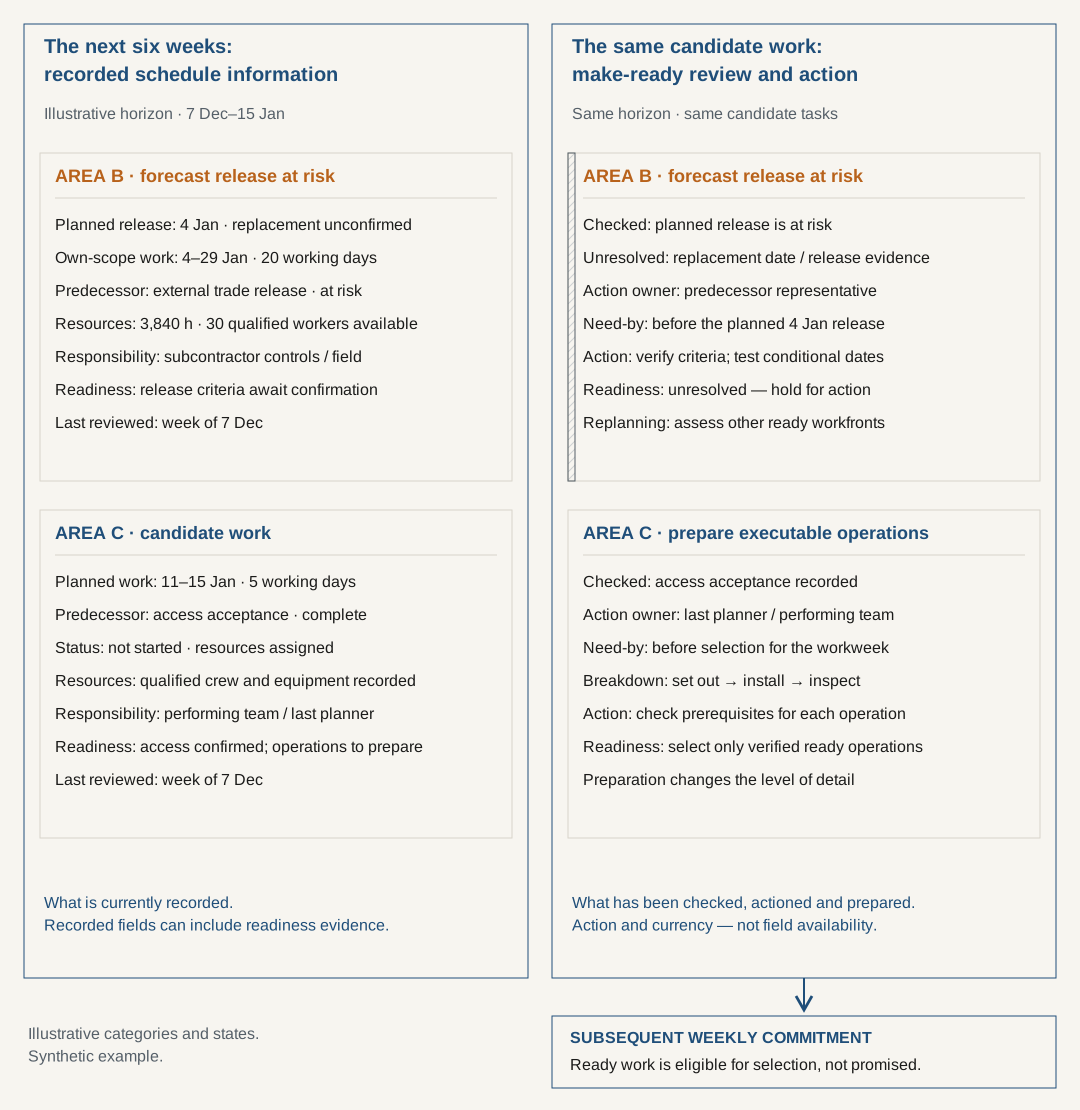
A filtered view displays the information already recorded in the schedule, which may include dependencies, responsibility, resources and readiness attributes.
Make-ready is a process. In the 2020 Current Process Benchmark, "the lookahead function within LPS is proactive. It involves making scheduled tasks ready, and replanning when some scheduled tasks cannot be made ready," and "'make ready' is done by identifying and removing any remaining constraints on scheduled tasks in the lookahead period, then breaking scheduled tasks down into operations, and designing those operations."2
The distinction is in the actions: identifying, clearing, decomposing, designing and replanning. Filtering alone performs none of them.
Figure 3 compares stored planning information with its active review and use to make work ready for subsequent commitment.
Timing follows from the horizon chosen. The benchmark puts it conditionally: "Assuming a 6-week lookahead window, constraint analysis starts 6 weeks ahead of scheduled task starts," with information and material constraints taken first because they are slowest to clear, and responsibility for removal distributed across the team rather than held by a planner.2 Six weeks is the assumed horizon here, not a universal duration. AACE's broader schedule-level guidance describes other rolling lookahead periods; it does not prescribe an LPS make-ready horizon.3
5. Different detail at different levels
The issue is whether the right detail is available and connected at each planning level. The Last Planner benchmark recommends milestone-level master planning at project start, with stated exceptions, and increasing detail as execution approaches.2 AACE's guidance describes a Level 3 control schedule that can support a meaningful CPM network — "neither too summarized nor too detailed" — and describes itself as "a guideline, not a standard."3 These sources address different planning purposes; neither prohibits the detail needed to manage dependencies.
Figure 4
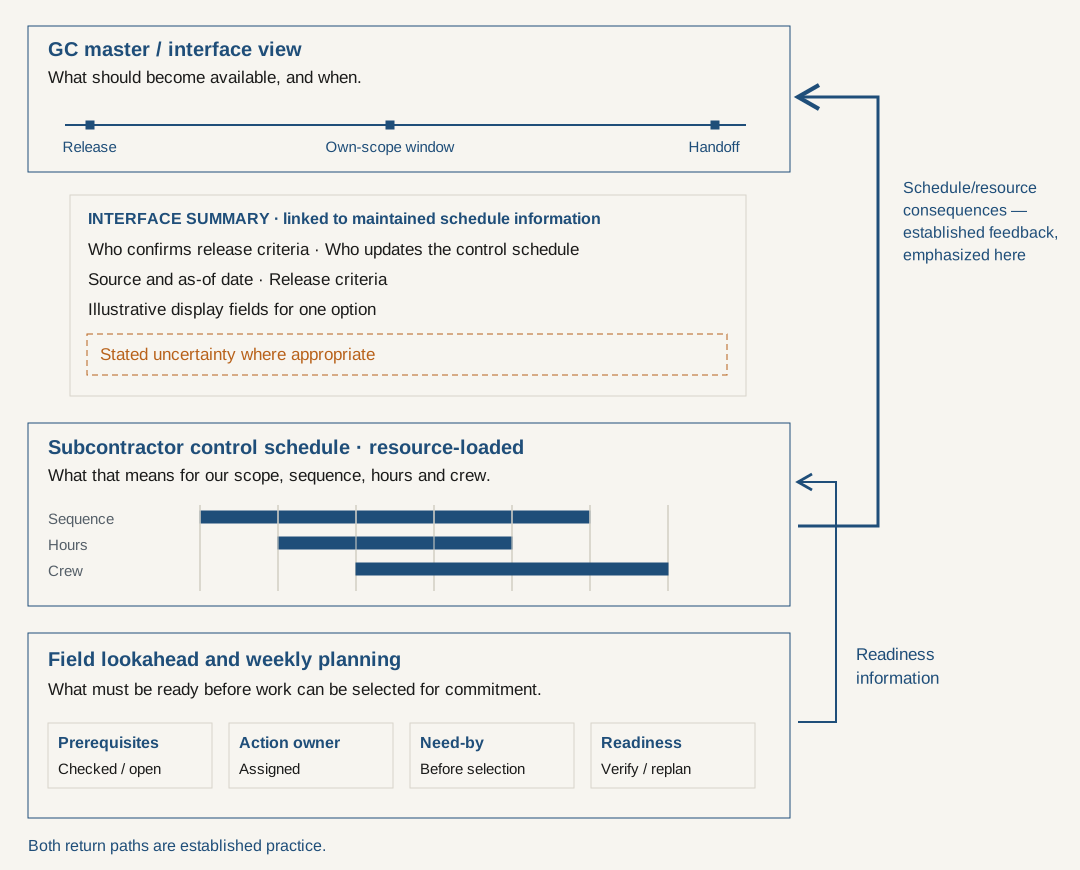
So three views, holding different detail, each answering a different question — what should become available and when; what that means for our scope, sequence, hours and crew; and what must be ready before work can be selected for commitment. Articles 001 and 002 live entirely in the middle one.
Cadences can differ too. The May 2025 UFGS guide pairs monthly NAS updates with weekly lookahead submissions. Its lookahead activities are limited to five working days; its specified contractor and subcontractor on-site construction activities are limited to twenty working days unless the Contracting Officer approves otherwise.5 This is one guide specification, applicable through the project's adopted requirements.
Different detail at different levels is a design choice. What deserves examination is what crosses between them, and when.
6. The subcontractor's position
In this example, the subcontractor's labour forecast depends on a workfront released by another trade. That is the position examined here.
AIA A401–2017 §3.2.1 is one standard-form example: it provides for schedule information, sufficient additional detail and prompt notice of changes, alongside cooperation and submittal-response duties.7 Whether those obligations apply depends on the executed subcontract; this clause does not specify native-file delivery. Field observations can provide earlier warning, but they still need confirmation and translation into forecast consequences.
Controls must reconcile that information with the current forecast while preserving the baseline and the record of changes.
7. A warning that did not reach the forecast
The following fictional timeline is constructed to illustrate a missed internal handoff. Its dates and elapsed time are assumptions, not observations.
| When | What happened |
|---|---|
| 2 December | The predecessor's superintendent warns that the planned 4 January release is at risk. No replacement date is yet confirmed. This warning falls within the example's assumed six-week horizon |
| Week of 7 December | The sub's lookahead records "forecast release at risk"; in this constructed case, the warning is not passed to controls for assessment |
| 18 December | The issued GC schedule still shows 4 January. The example does not establish why it remains unchanged |
| 8 January | The GC update records a forecast release of 14 January |
| 12 January | The sub's control schedule adopts that forecast date: assumed window 20 → 12 working days; demand 24 → 40 average worker-equivalents against 30 available |
In this constructed example, an early warning exists about six weeks before it appears in the control schedule. Constraint identification occurred, but the internal handoff did not. The warning could have triggered verification and a conditional resource assessment; it did not yet establish the eventual release date. The timeline does not allocate fault or show that this duration is representative.
8. Connecting readiness to the forecast
In this example, a readiness warning was recorded without a corresponding resource assessment. That is a failure to connect the information in this case, not a missing capability of production planning. PPC measures the proportion of weekly commitments completed as promised; reasons for variance support learning.1 Neither metric alone is a labour demand profile. Established planning methods also address capacity and replanning.2 For the subcontractor's forecast, the next connection is:
Figure 5
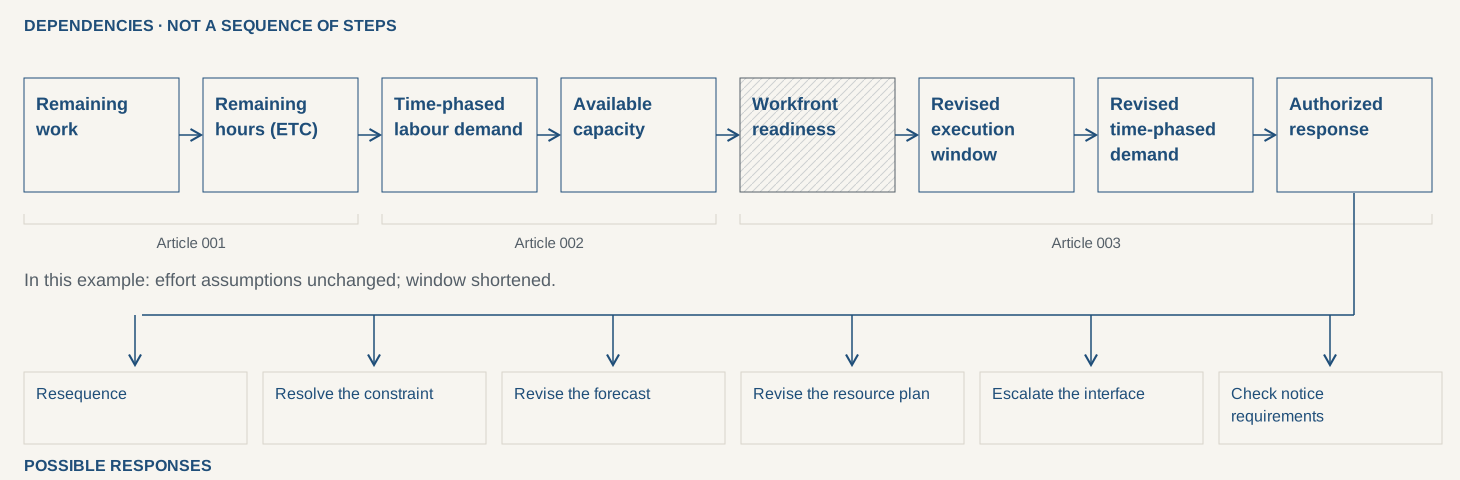
release assumption changes → assess the available execution window → revise time-phased demand where affected → compare with available capacity → consider an authorized response.
Possible responses may require different authorities; they are options to assess, not a prescribed sequence:
- Resequence — assess other ready workfronts and the effects on existing commitments.
- Resolve the constraint — ask the responsible party whether the blocker can be cleared in time.
- Revise the forecast — reflect supported changes to dates, sequence or remaining effort.
- Revise the resource plan — assess feasible crew or timing changes against qualifications, access and other commitments.
- Escalate the interface — seek a decision from the party authorized to resolve it.
- Check notice requirements — the authorized contract representative determines whether the executed contract and circumstances require a formal notice.
The forecast consequence helps the responsible people evaluate these options.
One point about timing is worth making explicit, because the worked example turns on it. A confirmed replacement date is not required to start. A warning that a release is at risk is enough to support a conditional assessment — if the release moves by this much, the window becomes this, and the required average becomes that — which can be revised when the date is confirmed. Testing the consequence of an assumption is not the same as adopting it.
9. Representing an external dependency
Established scheduling guidance includes reference or schedule-visibility activities for work outside the scheduler's owned scope.8 The project-specific question is which representation preserves the dependency with information that can be maintained and checked.
| Option | Useful when | Limit to make explicit |
|---|---|---|
| Release milestone | An agreed handoff needs a visible schedule interface | A supplied date without supporting logic can conceal upstream risk; a milestone need not be date-constrained |
| Reference activity or maintained external logic | Credible upstream progress and dependencies are available | Identify the external status source, update basis and responsibility; do not claim ownership of the other party's work |
| Narrative alongside the schedule | Explaining qualifications and uncertainty | Narrative alone does not propagate a dependency through the network |
A release milestone is one option. Identify the release criteria, who confirms them, the source and as-of date of the forecast, and who updates its representation in the control schedule. Where credible external logic is available, retain it rather than replace it with an arbitrary date constraint. Where the date is uncertain, show the assumption and test its consequence; a confidence label is not verification. Keep the interface reconciled with the schedule rather than independently maintaining another forecast.
In the worked example this matters at the 2 December warning rather than at the 8 January update. At that point there is no confirmed date to record — only a stated risk to an assumption already in the schedule. Whichever representation carries that assumption, what the situation calls for is the uncertainty made visible and its consequence tested, not a new date.
10. What this does not settle
That the window change altered the hours. It did not, here, because scope and effort assumptions were held constant. Compression into a stacked area is a candidate productivity change — congestion, out-of-sequence working, supervision dilution — each needing its own estimating basis. That is Article 001's subject, and quantifying it here would be inventing a number.
That 40.0 is a headcount. It is an average across a window: not a daily peak, not a roster, not an instruction to mobilise.
That earlier warning would have changed the outcome. Earlier warning could have allowed an earlier assessment. Whether it changed available actions, contractual position or the outcome is not established by this example.
That any of this is new. Make-ready planning, schedule levels of detail, reference activities, resource levelling and capacity-aware replanning are established, named and published. This article explains that established connection from the subcontractor's forecasting perspective.
Key takeaways
- A labour forecast depends on when the work can be performed. That dependency is not settled by the arithmetic that produced the hours.
- Filtering a schedule to the next six weeks does not perform make-ready planning. Both can start from the same candidate work; the distinction is the identifying, clearing, decomposing, designing and replanning applied to it.
- Distinguish a CPM date constraint, a make-ready constraint and a resource limit. They can describe related aspects of the same problem.
- With scope and effort assumptions held constant, a later release against a fixed finish increases the required average labour rate. The synthetic example rises from 24.0 to 40.0 average worker-equivalents against 30 available.
- Readiness and resource consequences must be reconciled. Established practice addresses both; identify who carries the information into the subcontractor's forecast.
Open questions
I would value practitioners' experience on any of these.
- When an external release assumption changes on your projects, what route does that information take before it reaches the labour forecast?
- How do you represent and maintain external dependencies, and what information supports that representation?
- What confirms a release — who states the criteria, and what is the source and as-of date of the forecast you rely on?
- Who converts a changed release assumption into a resource assessment, and on what trigger?
References
-
Lean Construction Institute. Last Planner System. Definition of the system; the Should / Can / Will / Did / Learn conversations; the last planner and reliable commitment; Percent Plan Complete and Reasons for Variance. Accessed 16 September 2026. https://leanconstruction.org/lean-topics/last-planner-system/ ↩ ↩2 ↩3 ↩4
-
Ballard, G. & Tommelein, I.D. (2021). 2020 Current Process Benchmark for the Last Planner® System of Project Planning and Control, University of California, Berkeley, 20 March 2021 — the lookahead function and the definition of "make ready" (p. 29); constraint analysis timing, stated conditionally on a six-week window (p. 29); milestone-level master planning at project start, with stated exceptions, and increasing detail as execution approaches (p. 10); capacity and replanning (pp. 42, 67–68). https://p2sl.berkeley.edu/wp-content/uploads/2021/03/Ballard_Tommelein-2021-LPS-Benchmark-2020-2.pdf ↩ ↩2 ↩3 ↩4 ↩5
-
AACE International (2010). Recommended Practice 37R-06: Schedule Levels of Detail — As Applied in Engineering, Procurement, and Construction, 20 March 2010 — self-described as "a guideline, not a standard"; Level 3; rolling look-ahead periods at Levels 4-X. https://web.aacei.org/docs/default-source/toc/toc_37r-06.pdf ↩ ↩2
-
Oracle. Primavera P6 EPPM User Guide, Version 24 — About Constraints. Vendor documentation, cited for the product's own definition only. Accessed 16 September 2026. https://docs.oracle.com/cd/F88966_01/English/User_Guides/p6_eppm_user/6613.htm ↩
-
UFGS-01 32 17.00 20, Cost-Loaded Network Analysis Schedules (NAS), USACE / NAVFAC / AFCEC, May 2025 — monthly NAS update; weekly Look Ahead Schedule submission; five-working-day limit on Look Ahead activities; twenty-working-day limit on specified on-site construction activities unless the Contracting Officer approves otherwise. One guide specification, applicable through a project's adopted requirements. https://www.wbdg.org/FFC/NAVFAC/NDBM/UFGS/01_32_17.00_20.pdf ↩
-
Tommelein, I.D. & Emdanat, S. (2022). Takt Planning: An Enabler for Lean Construction. Proceedings of the 30th Annual Conference of the International Group for Lean Construction. Takt as a method used within the Last Planner System. The paper makes no comparison between takt and critical-path scheduling. https://iglcstorage.blob.core.windows.net/papers/attachment-b7bc2b9a-e435-41ec-a7b5-d82f6e7f4a11.pdf ↩
-
AIA Document A401™–2017, Standard Form of Agreement Between Contractor and Subcontractor, § 3.2.1. One standard form among several; whether these obligations apply depends on the executed subcontract. Not advice about any particular contract. https://assets.aiacontracts.com/ctrzdweb02/zdpdfs/preview_a401-2017.pdf ↩
-
U.S. Government Accountability Office (2015). GAO Schedule Assessment Guide: Best Practices for Project Schedules, GAO-16-89G, p. 38 — reference / schedule-visibility activities for work outside the scheduler's owned scope. https://www.gao.gov/assets/gao-16-89g.pdf ↩